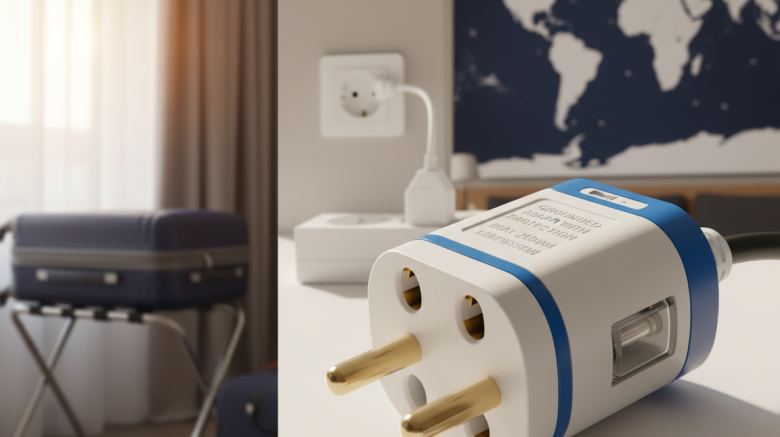
Choosing the correct electrical adapter for travel is important for preventing hazards and keeping devices operating properly. Created for travelers from the U.S., this guide explains how to choose a grounding adaptor plug and grounded plug adapter for worldwide travel. It explains the importance of a grounding adapter and highlights safe, convenient plug adaptor and outlet adaptor models.
Discover more about Grounded Adapter
Many current chargers work on a 100–240V input range, so a plug adaptor is usually enough for phones and laptops. Yet, devices like motors, hair tools, and certain appliances might require a voltage converter alongside a three-prong adapter. Familiarity with regional outlet types — such as Type A/B, C, E/F, G, and I — is essential for choosing the correct grounding adapter before departure.
When comparing travel models, consider options like the Ceptics GaN 70W Universal Travel Adapter, Tessan GaN 65W, and Epicka Pulse. If you want compact or budget-conscious choices, the Ceptics 6-in-1 and One Beat Travel Plug Adapter provide grounded or partially grounded ports at lower prices. If you need to run higher-power equipment, the Arsmel VisaPro and Ceptics travel power strip supply multiple grounded outlets.
Important Takeaways
- Use a grounding adaptor plug when devices or hotel outlets lack a reliable ground.
- Because most USB chargers accept 100–240V, a plug adaptor is usually enough and a voltage converter is often unnecessary.
- Choose plug types (A/B, C, E/F, G, I) according to your destination to ensure compatibility.
- Choose grounded plug adapter models like Ceptics, Tessan, or Epicka for safety and USB power.
- For safe use, high-power devices can require a voltage converter along with a three-prong adapter.
- For wholesale needs, distributors like Installation Parts Supply can provide grounded outlet adaptors and travel power strips.
Understanding Grounding Adaptor Plug Safety And The Importance Of Grounding
Grounding is essential for safety when using unfamiliar outlets. It creates an earth path that can trigger a breaker or redirect fault current. This protects both people and sensitive electronics from damage. A lot of travelers underestimate grounding until a faulty device causes a shock or damages their equipment.
What grounding does: protection against shocks and equipment damage
Grounding reduces the voltage that can appear on exposed metal parts. When insulation fails, the earth connection offers a low-resistance route for current. That sharply reduces the risk of electric shock and protects many devices against fault currents.
Common ground-related terms to know
Before you shop, it helps to understand the main grounding terms. A ground plug adapter allows three-prong cords to fit local sockets properly. You may see products labeled as grounded adapters or outlet ground adapters. Understanding these terms helps you choose an adapter that offers a genuine earth connection.
How Grounded Outlets Vary By Country And Outlet Type
Outlet designs vary widely around the world. In the U.S., Type B outlets have a round ground pin with two flat blades. In Europe, Type E and F outlets supply earth by way of a top contact or side clips. The U.K. uses Type G with a rectangular earth pin. Australia and parts of Asia employ Type I, featuring an earth blade below two angled live and neutral prongs. Most universal travel kits include these popular types, but they can still miss uncommon regional sockets.
When Grounding Is Required: Motors, Appliances, And Sensitive Electronics
Not all devices need grounding. Double-insulated USB chargers and phone adapters can often run safely without grounding. Yet, devices with motors, heating elements, power tools, desktop computers, and audio amplifiers require a solid earth path. If your device has a three-prong cord, it’s wise to carry a quality ground plug adapter or an outlet ground adapter that maintains the earth connection.
Choosing The Right Ground Adapter For Travel: Types, Compatibility, And Use
Picking the correct travel adapter is important for keeping your devices safe and working. A compact grounded solution is especially useful for protecting laptops, chargers, and camera gear. This section is meant to help you find the right match for your travel needs so your grounded plug adapter performs as intended.
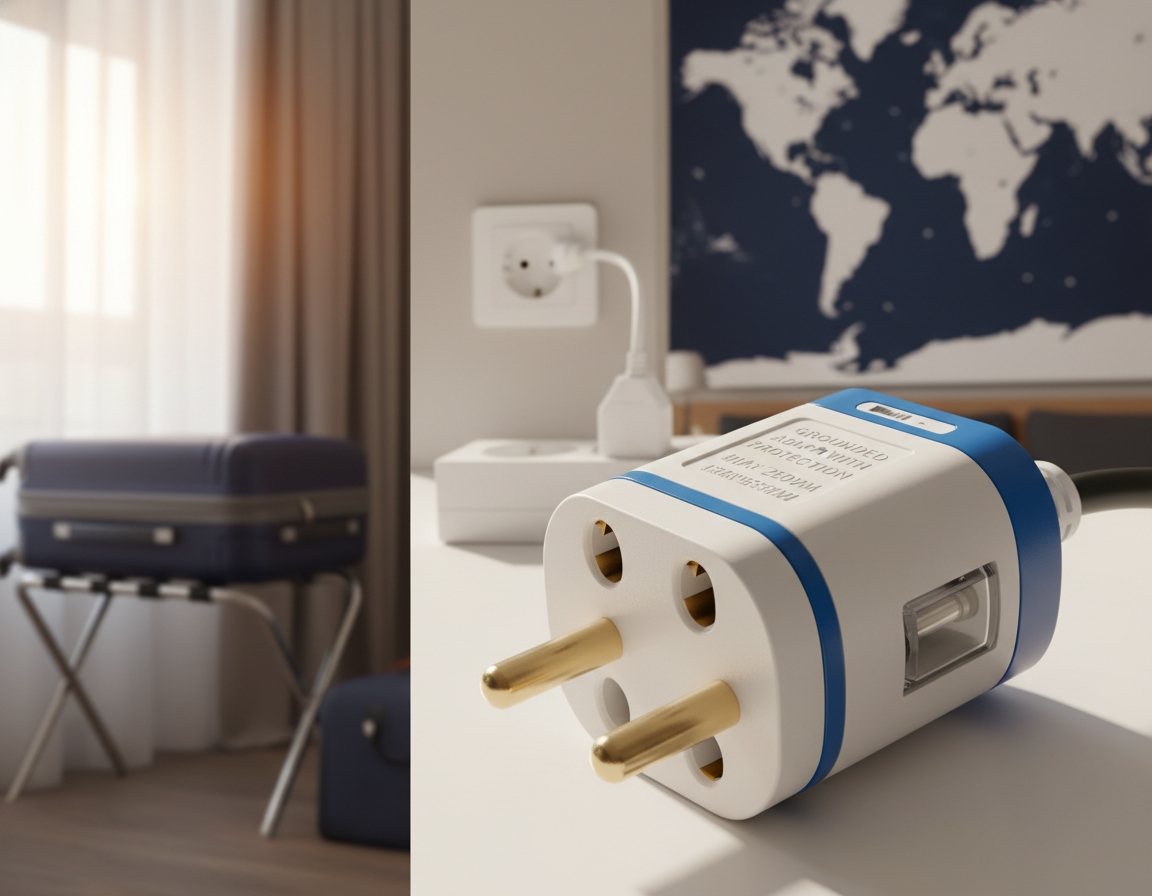
Universal Travel Adapters Versus Single-Country Plug Adaptors
Universal travel adapters like the Ceptics GaN 70W, Tessan 65W, and Epicka Pulse 45W support multiple plug types, including A, C, G, and I. They also come with USB ports, making them ideal for trips to multiple countries. This eliminates the need for multiple electrical plug adapters.
Universal adapters are convenient because they combine multiple prong sets with USB charging. Still, they can be bulkier and sometimes more likely to suffer mechanical wear or failure. Their charging speeds can also be slower than those of dedicated chargers.
Single-country plug adaptors, on the other hand, tend to be smaller and more dependable for region-specific trips. Using them alongside a trusted multiport USB charger can help save space. It’s important to check the outlet styles before purchasing a plug converter, as some countries use uncommon types like D, H, or M.
Grounding Plug Adapter Form Factors And Styles
Three-prong adapters provide an earth pin for devices that require a true protective earth connection. They are essential for appliances that include a grounding prong.
A grounded adapter keeps the ground path intact whenever the wall outlet supports grounding. That is critical if surge protection and safety circuits are expected to function correctly.
By comparison, a ground lift adapter disconnects or isolates the earth connection. It’s often used by audio technicians to eliminate ground-loop hum. However, it should not be trusted as a safety solution because it defeats the protective earth.
Matching Plug Types To Destinations Using A Plug Style Guide
It is important to match both the plug body and grounding style to local sockets. You will commonly find Type A/B in the US, Canada, and Japan. Type C is common throughout continental Europe and in parts of South America. Type D is found in India, while Type E/F is used in several European countries. Type G is standard in the UK and Ireland, while Type I is used in Australia, New Zealand, and parts of China.
As you select an adapter, confirm that it fits properly and matches the grounding requirements of your device. A grounded plug adapter that fits but does not preserve the ground provides very little protection.
| Plug Type | Common Countries | Grounding | Recommended Adapter |
|---|---|---|---|
| Type A/B | United States, Canada, Japan | Type B includes earth pin | Three-prong adapter or grounded adapter for Type B |
| Type C | Most of Europe, South America | No dedicated earth on standard two-pin plugs | Universal adapter with a secure fit or a regional plug converter |
| Type D | India, Nepal | Older three-pin format with earth | Single-country plug adaptor or universal that lists Type D |
| Type E/F | France, Germany, and parts of Europe | Earth through a pin (E) or side contacts (F) | Grounded adapter that preserves pin/contact earth |
| Type G | UK, Ireland, Hong Kong | Large rectangular ground pin | Grounding adapter or dedicated UK plug adaptor |
| Type I | Australia, New Zealand, and parts of China | Flat angled live and neutral blades with earth pin | Universal adapter supporting Type I or single-country adaptor |
When You Might Need A Voltage Converter In Addition To A Plug Adaptor
A large share of modern electronics can operate within a 100–240V range. Devices marked “Input: 100–220V” usually need only a plug converter to fit the outlet shape.
High-wattage appliances with heaters or motors often necessitate a voltage converter or a local replacement. A Ceptics 2,000-watt travel voltage converter can power heavy hair dryers but has limitations and may not work with electronics that use electronic controls.
If you are unsure, it is usually better to leave heavy appliances at home or buy local versions. For electronics that require earth, use a grounded plug adapter, and only add a proper plug converter when the device does not show voltage compatibility.
Top Grounding Adapters And Travel-Friendly Electrical Adapter Options
Travelers who want dependable power should choose grounded options that match both their device needs and the outlets at their destination. Grounded plugs improve safety for laptops and various other appliances. Below are compact, higher-power, and wholesale options to help you choose the best grounding adapters for your journey.
Top Overall Travel Adapters With Grounded Outlets And USB Ports
The Ceptics GaN 70W Universal Travel Adapter stands out for its versatility across multiple countries. It accommodates Type A, C, G, and I plugs and offers high-power USB-C for charging laptops and phones. The Tessan GaN 65W is another strong option, balancing price and power well. If you want a compact hybrid with multiple USB ports, the Epicka Pulse 45W is a good choice. Each of these models supports grounded use where the outlet design allows it.
Compact and budget grounded options
For those prioritizing light packing and casual travel, the Ceptics 6-in-1 Worldwide Travel Adapter is an economical choice. This model gives you basic grounded plug coverage without a high cost. Anker’s European Travel Plug Adapter provides a single grounded US outlet, USB ports, and overload protection for lighter loads. The One Beat Travel Plug Adapter is another simple, effective option for budget-conscious travelers who need access to grounded sockets in various plug configurations.
High-power and multi-outlet solutions for grounded use
For those requiring more wattage or multiple grounded sockets, the Arsmel VisaPro All-in-One 170W is a robust solution. Ceptics also makes travel power strips with multiple grounded US outlets and interchangeable heads for different regions. They are ideal when you need to power several chargers, camera devices, or small appliances and still maintain grounding.
Where To Buy Wholesale Grounding Adapters And Distributor Tips
For wholesale orders, Installation Parts Supply is a dependable source for grounded plug adapters and related electrical adapter hardware. Manufacturer stores like Ceptics and well-known brands such as Anker provide single-unit purchases with detailed specifications. Before purchasing, whether in bulk or retail, always verify certifications like CE, RoHS, and FCC and confirm that built-in fuses or overload protection are included.
| Model | Typical Price (USD) | Grounded Outlet | USB Ports | Best for |
|---|---|---|---|---|
| Ceptics GaN 70W | $45 | Yes (interchangeable heads) | 2–3, including USB-C | Multi-country laptop power |
| Tessan GaN 65W | $38 | Yes | 2–3 | Balanced power and portability |
| Epicka Pulse 45W | $30 | Yes, where the outlet supports grounding | 2–3 | Compact hybrid charging |
| Ceptics 6-in-1 | $19 | Yes | 0–1 | Budget travel with basic needs |
| Anker European Travel Plug Adapter | $16 | One grounded US outlet | 1–2 with limited total wattage | Short European trips and phone charging |
| Arsmel VisaPro 170W | $80 | Yes | Multiple ports (varies) | High-power multi-device setups |
| One Beat Travel Plug Adapter | $15 | Yes | 0–1 | Affordable outlet adaptor for basic use |
How To Safely Use Grounding Adapters On The Road
Before you leave, test your grounding plug adapter kit. Plug in chargers, laptops, and higher-wattage devices at home first. This helps make sure they fit correctly and operate as expected. Bring at least one adapter in your carry-on to allow immediate charging after arrival. You should also keep power banks in your carry-on because many airlines restrict capacity to about 27,000 mAh.
Always confirm that your adapter suits your device’s requirements. Check the plug adaptor’s wattage rating and port limits. These products range from small USB chargers to travel hubs rated from 30–170W. Use a three-prong adapter or grounded plug adapter when the outlet has an earth connection. Do not force motors or heaters into adapters that do not have the required capacity.
Whenever you can, use grounded options. For appliances and sensitive electronics, grounded plug adapters or outlet ground adapters are the safer choice. Ground-lift adapters should only be used if you understand the risks of audio ground loops and accept the loss of protective earth.
Before each use, inspect your grounding plug adapter carefully. Check for signs of damage, including cracked housings, loose prongs, or rattling inserts. Any damaged adapter should be replaced immediately. Instead of daisy-chaining multiple adapters, use travel power strips with built-in protection.
Check local outlets as soon as you arrive. Use an outlet style guide to identify different types like Type A/B, C, E/F, G, I, and less common ones. In older buildings or countries with Type L or N, ask your host for a rated power strip or buy a local adapter to ensure grounding.
Certified products are the safer choice. Look for safety marks such as CE, FCC, or RoHS and features like fuses or overload protection. Travel adapters from brands like Anker, Ceptics, and Epicka often include these protections.
Keep voltage labels in mind before plugging anything in. If a device is marked 100–220V 50/60Hz, a plug adaptor is usually enough. For other ratings, use a proper voltage converter to avoid damage. Modern multiport GaN chargers accept wide input ranges and generate less heat while charging multiple devices.
Follow a few simple daily habits for better safety. Unplug adapters when they are not in use, avoid wet or overcrowded outlets, and make sure outlet ground adapters fit firmly. These habits reduce risks and keep you powered safely while traveling.
Troubleshooting Grounding Adapter Issues And Hotel Outlet Quirks
Stiff or failing parts often cause issues with grounding adapters. Before using the adapter, check its prongs and locking mechanisms carefully. Certain adapters, including the Ceptics 65W World Travel Adapter, have both grounded and non-grounded outlets. Make sure you understand which outlet is appropriate for your devices.
Outlets can differ greatly, even in the same city. In older European outlets or Italian Type L sockets, Europlugs may not fit securely. Vintage hotel outlets are sometimes loose or missing a ground pin. When an adapter does not fit, ask the front desk for a different outlet or a power strip.
If a socket appears ungrounded or miswired, do not plug in equipment that requires earth. In that case, rely on double-insulated devices or a certified isolating adapter instead. For faults related specifically to grounding, check continuity with a small outlet tester or a multimeter.
If a grounded plug adapter shows no ground continuity, the outlet may lack a proper earth or be miswired. Do not rely on that outlet for surge-prone equipment. Ground lift adapters can remove hum in audio setups, but they also remove the protective earth. They should never be used with appliances that require a safety ground.
For high-wattage failures, remember voltage mismatch—220V versus 120V—is often the real cause. This calls for a proper voltage converter, not just an electrical adapter.
Pack a compact, well-rated universal adapter from trusted brands such as Ceptics, Tessan, or Epicka. Keep a few single-country plug adapters on hand. An outlet ground adapter or a basic outlet tester can help you check safety fast. For larger needs or installer-grade grounded adapters, contact distributors like Installation Parts Supply to source grounded plug adapter hardware and compatible grounding adapters in bulk.